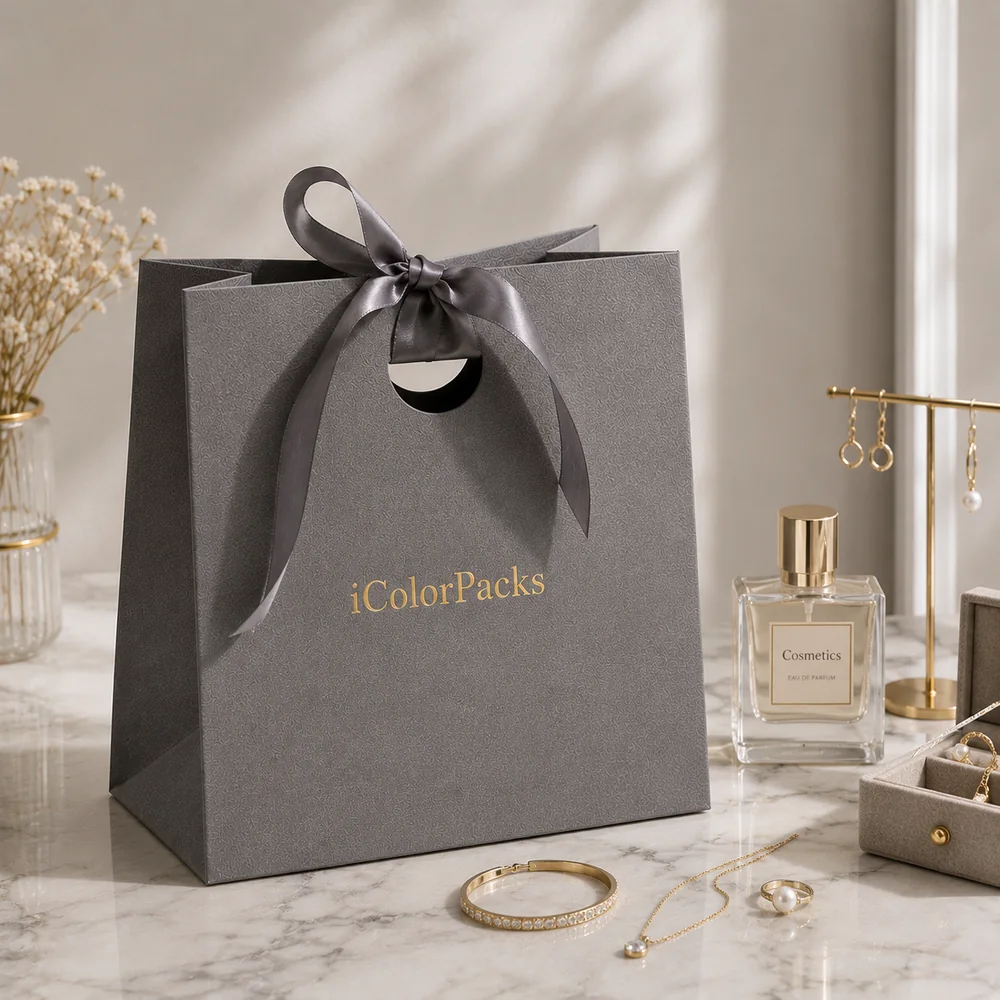
Buying answer: Choose a bag that fits and carries your product first. Then compare a plain bag with a branded seal, a printed bag, and a foil-finished bag using the same dimensions and order quantity. A premium surface cannot compensate for weak handles or an unsuitable size.
Why buyers ask for a simpler first order
Small-brand discussions on Reddit raise a useful question: should the first packaging run use a stock format with labels, or a fully custom specification? That is a budgeting decision, not a test of whether your brand is premium. Your first run needs to protect cash, fit the product and reveal what customers actually use.
Compare three routes before choosing a finish
| Route | When to compare it | What to check |
|---|---|---|
| Plain bag + printed seal or tag | Testing a range or seasonal message | Available stock size, label adhesion, application labor and whether the result suits your store |
| Custom printed bag | Brand color or a repeated graphic is important | Print coverage, paper shade, setup costs and reorder consistency |
| Specialty paper + foil or embossing | A tactile surface or metallic logo matters to presentation | Fine logo detail, foil adhesion, textured-paper compatibility and handling marks |
Why 100 bags can cost more per piece than 500
Artwork preparation, print setup and any required tooling are distributed over the run. Changing the artwork or size can create another setup. Ask for quotes at 100, 500 and 1,000 pieces with every other specification held constant. iColorPacks custom orders start at 100 pieces per size and artwork; this does not mean all methods have the same unit cost.
Request separate lines for bags, handles, bottom reinforcement, decoration, tooling, samples and delivery. Ask which charges repeat on the next order and whether tooling is retained. Avoid comparing an unprinted local stock bag with a custom bag whose price already includes branding and freight.
Approve construction before surface decoration
- Measure the product in its retail box, with ribbon or protective wrapping included. State finished width × gusset × height and usable space.
- Provide the total filled weight. Check the complete sample rather than assuming GSM proves carrying strength.
- Specify cord or ribbon width, handle drop, punched-hole positions, attachment and reinforcement. State explicitly if you do not want metal eyelets.
- Check the base and handle attachment with representative contents. Agree a carrying test before bulk approval.
Inspect the finish under ordinary use
Review logo size and position on the actual chosen paper. Ask the supplier to identify which sample reproduces the final print or foil process; a digital mockup cannot establish the appearance of metallic foil. Inspect folds, edges and a lightly handled surface, including whether marks are acceptable for your intended use.
A textured stock can change fine-line reproduction. Dark surfaces may show scuffs or fingerprints differently from light ones. Agree the acceptable reference physically rather than relying on a phrase such as “luxury quality.”
Send this quotation brief
- Bag width × gusset × height, units, product dimensions and filled weight.
- Quantity per artwork; paper grade, GSM, lamination or coating.
- Handle material, width, drop and attachment; top and base reinforcement.
- Logo vector file, print colors, foil area and sample requirements.
- Destination/postcode, packing method and required arrival date.
Compare paper bag options and the detailed sample approval checklist. Order enough to test the design without allowing a lower unit price to dictate an unmanageable stock level.
Request a specification-based quote
Send dimensions, quantity, artwork and destination. Samples, production and freight are confirmed for your project.
Discuss this guide with Jennifer · Send a packaging inquiry